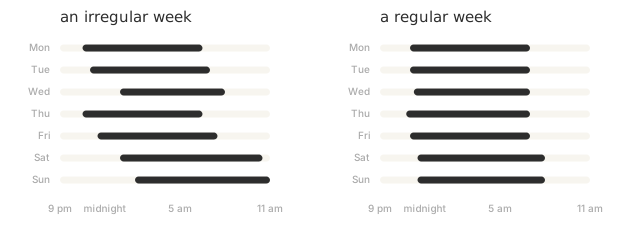
It is Thursday, and you are in bed by half past ten because you have an early start. On Friday you stay up until one. On Saturday you sleep until eleven and feel oddly groggy, even though you slept nine hours. By Sunday night you lie awake at eleven, not tired at all, already dreading Monday.
If you add it up, you may well be getting “enough” sleep across the week. But your body has been living in three different time zones without leaving home. For a long time, sleep advice focused almost entirely on one number: seven to nine hours. A growing body of research suggests there is a second number worth paying attention to, and it is about timing rather than length.
What the research shows
The clearest study on this so far comes from the UK Biobank. Daniel Windred and colleagues looked at 60,977 adults, with an average age of about 63, who wore a wrist activity tracker for seven days (Windred et al., 2024). From the data, the researchers calculated a Sleep Regularity Index: a score for how similar a person’s sleep and wake times were from one day to the next. They then followed participants for about six years.
A second UK Biobank analysis looked at heart health in 72,269 adults aged 40 to 79 over about eight years (Chaput et al., 2025). People with the most irregular sleep had a 26% higher risk of a major cardiovascular event, such as a heart attack or stroke, than people with regular sleep. Moderately irregular sleepers had an 8% higher risk. Notably, for the most irregular sleepers, getting the recommended number of hours did not seem to cancel out the higher risk.
These findings fit with a consensus statement from an expert panel of the US National Sleep Foundation. After reviewing the evidence, the panel concluded that consistent timing of falling asleep and waking up is important for health, safety and performance (Sletten et al., 2023). Interestingly, they also concluded that catch-up sleep on non-work days may be beneficial when weekday sleep is too short, so the message is not “never sleep in”.
An honest caveat
All of this is observational research. It shows that regular sleep is linked to better health, not that changing your bedtime will cause those benefits. People with very irregular sleep may also differ in other ways, such as shift work, stress or existing health problems, and statistics can only partly account for that. The percentages describe large groups, not what will happen to any one person.
The measurement itself is also still being refined. A 2025 analysis of more than 70,000 UK Biobank participants found that two widely used software tools for calculating sleep regularity gave quite different scores for the same people, and the choice of tool changed how strongly irregular sleep appeared to be linked to health outcomes (Czeisler et al., 2025). The researchers have proposed reporting standards so that future studies are easier to compare. So treat the exact numbers with some caution. The broader picture, that a steadier rhythm is a sensible thing to aim for, is supported by several lines of research.
“Your body doesn’t only count the hours. It also notices when they happen.”
Why this matters
There is something quietly encouraging in this research. Getting more sleep is not always within your control. Deadlines, small children, noise or a racing mind can all cut the night short. Regularity, on the other hand, is often easier to influence, especially at one end of the night: the time you get up.
It also shifts the goal away from perfection. You do not need a flawless eight hours every night. A rhythm that is roughly similar most days, with some flexibility at weekends, is a realistic place to start, and it is something you can practise like any other habit.
How to apply it with the four steps
- 1. Notice. For one week, write down when you go to bed, roughly when you fall asleep and when you get up. No tracker needed: a note on your phone is enough. At the end of the week, look at the spread. How far apart are your earliest and latest wake-up times? Many people are surprised by how different their weekdays and weekends are.
- 2. Shrink. Do not overhaul everything at once. Choose one anchor, ideally your wake-up time, and aim to keep it within about an hour on most days, including weekends. If your weekend lie-ins are currently three hours longer, try making them two hours longer first. Small and steady beats ambitious and short-lived.
- 3. Plan. A regular bedtime starts before bed. Use an if–then plan to make your wind-down automatic: “If it’s 10:15 pm, then I put my phone on the charger in the kitchen.” Or: “If I’ve brushed my teeth, then I dim the lights and read for ten minutes.” The cue does the remembering for you.
- 4. Adjust. After a week or two, look back. Which nights went off track, and why? Maybe Friday plans always run late, which is fine. Plan for it instead of fighting it, for example by keeping Saturday’s wake-up time only slightly later. Sleep rhythms shift gradually, so give yourself time and change one thing at a time.
Try it this week
- Track seven days. Note your bedtime and wake-up time every day, without judging the numbers.
- Pick your anchor. Choose a wake-up time you can realistically keep on most days, weekends included (give or take an hour).
- Write one wind-down plan. One if–then sentence for the evening, attached to something that already happens.
- Review on Sunday. Compare your earliest and latest wake-up times. A smaller gap than last week counts as progress.
If you have struggled with sleep for several weeks, often wake up exhausted, snore loudly or have been told you stop breathing at night, or if your work involves night shifts, it is worth talking to your GP or a sleep specialist.
Free tools
Build your wind-down if–then plan