
You know that scrolling until midnight leaves you tired the next day. You know that a short walk would clear your head. You know that a proper breakfast beats another coffee. And still, you do the opposite, again and again.
If that sounds familiar, you are in very good company. And the reason has much less to do with discipline than most of us were taught to believe.
The gap between knowing and doing
Psychologists call it the intention–behaviour gap. In a large meta-analysis of experiments, Webb and Sheeran (2006) found that even when interventions produced a medium-to-large change in people's intentions, the change in their actual behaviour was only small to medium. Wanting to change is necessary, but it is nowhere near enough.
That is good news in a quiet way. It means that struggling to follow through is not a character flaw. It is what happens to almost everyone when good intentions meet a busy, tired, distracting real life.
"Change rarely needs a new you. It needs a smaller step and a clearer moment."
Why more willpower is the wrong tool
Much of what we do each day is not decided in the moment at all. Habits are behaviours that have become linked to a context: a place, a time, a preceding action, a feeling (Wood & Neal, 2007). You reach for your phone in bed not because you decided to, but because the bed has become the cue.
Trying to overcome a habit with motivation alone means fighting the same battle every evening, with a tired brain. A better strategy is to work with the way habits form: make the action small, tie it to a cue, and shape your surroundings so the helpful choice is the easy one. Researchers who study behaviour change describe this in terms of capability, opportunity and motivation, and they point out that all three matter, not just motivation (Michie et al., 2011).
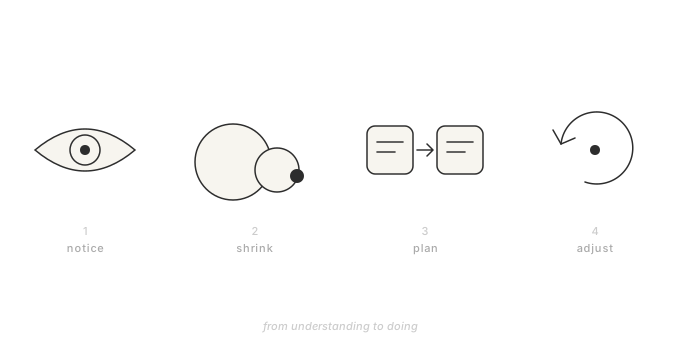
Four steps that help
- 1. Notice. Before you change anything, watch what actually happens. When do you skip the walk? What is going on right before you reach for sugar? Understanding the pattern without judging it shows you what to change. Our "What's in the way?" tool can help you name the barrier.
- 2. Shrink. Make the action so small that it feels almost silly: one glass of water, two minutes of stretching, three slow breaths. A useful test is to ask how sure you are that you would do it on a bad day. If the answer is below eight out of ten, shrink it further.
- 3. Plan. Decide in advance when and where you will act, in the form "If X happens, then I will do Y." These so-called implementation intentions have a medium-to-large effect on goal achievement, according to a meta-analysis of close to a hundred studies (Gollwitzer & Sheeran, 2006). The plan does the remembering and the deciding for you.
- 4. Adjust. After a week, look back. What helped, what got in the way? Change the plan or the environment, not yourself. If you missed a few days, pick it up at the next cue instead of starting over. Self-compassion after a slip is linked to more motivation to improve, not less (Breines & Chen, 2012).
How long does it really take?
You may have heard that habits form in 21 days. The best-known study on the question followed 96 people over twelve weeks as they built a new daily habit (Lally et al., 2010). On average it took about 66 days for the behaviour to feel automatic, and the range between people and habits was enormous, from under three weeks to well over eight months. Missing a single day did not derail the process.
So be patient with yourself. A slow start with a small, well-planned action is not failing. It is how lasting habits are built.
Try it this week
Pick one habit you care about. Then take ten minutes:
- Name the barrier. What most often gets in the way?
- Choose a tiny version you could do even on your worst day.
- Write one if–then plan and put a visible reminder where the cue happens.
- Check in after seven days and adjust.
If low mood or exhaustion has been making all of this feel impossible for a while, it is worth talking to someone you trust or a professional. Habits are not a replacement for support.
Free tools
Build your first if–then plan