It’s 4 pm. You meant to go for a run this morning, then the day happened. Now there’s a quiet voice saying: “If I can’t do a proper workout, there’s no point.” So you do nothing, and tomorrow the plan starts again from zero.
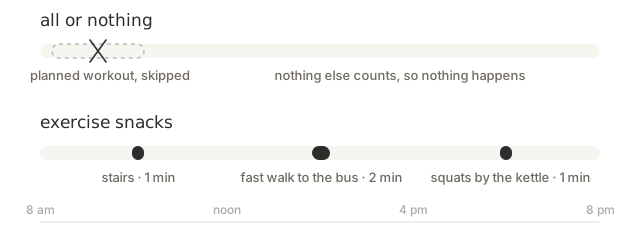
That voice has a hidden rule in it: movement only counts if it’s big. Thirty minutes, a gym bag, a shower afterwards. Research on short bursts of activity, sometimes called “exercise snacks”, suggests the opposite. Small pieces of movement, spread through the day, seem to add up to more than you’d think.
What the research shows
Short bursts in everyday life. In 2022, Emmanuel Stamatakis and colleagues looked at 25,241 adults in the UK Biobank who said they didn’t exercise in their free time at all (Stamatakis et al., 2022). Each wore a wrist sensor for a week, and the researchers picked out very short bursts of vigorous movement that happen as part of normal life: hurrying up the stairs, carrying shopping briskly, walking fast to catch a bus. They called this “vigorous intermittent lifestyle physical activity”.
Trials of exercise snacks. A 2025 meta-analysis by Wan and colleagues pulled together 14 studies with 483 adults who were given planned “exercise snacks”: short bouts, often stair climbing or bodyweight moves, a few times a day (Wan et al., 2025). Compared with control groups, the snack groups improved their cardiorespiratory fitness (the measure called VO₂max) and had slightly lower total and LDL cholesterol. Body weight and body fat didn’t change. The benefits were most visible in people who were inactive to begin with.
An expert consensus. Also in 2025, an international group of researchers published the first consensus statement on short bouts of accumulated exercise in the Journal of Sport and Health Science (Yin et al., 2025). They define these as bouts of up to 10 minutes, done at least twice a day and built into daily life, and concluded that this approach is feasible and safe for many people and can improve outcomes such as fitness, blood pressure and blood sugar control.
An honest caveat
None of this means a minute on the stairs replaces everything else. The big mortality findings come from an observational study, so other differences between people may play a part. The trials were mostly small and short, and several had some risk of bias. And “vigorous” matters here: the bursts in these studies were brisk enough to make you breathe harder, not a gentle stroll.
What the research does support is a kinder starting point. If a full workout isn’t happening today, a small burst isn’t pointless. It’s a real piece of movement.
“You don’t need a free hour. You need a staircase and sixty seconds.”
Why this matters
All-or-nothing thinking is one of the most common reasons habits stall. When the only option is “a proper workout”, a busy day turns into a zero day, and a few zero days turn into “I’ve stopped” (more on that in a missed day is information, not failure).
Exercise snacks give you a version of the habit that still fits on a bad day. That’s exactly what keeps a habit alive: the cue and the action keep happening, even when they’re small. It’s the same idea behind what makes a habit stick: easy, regular and your own.
How to apply it with the four steps
- 1. Notice. Look at one ordinary day. Where are the natural moments you already move: stairs, the walk to the bus, the trip to the kitchen? Where do you sit for more than an hour without a break?
- 2. Shrink. Pick one burst that takes one to two minutes and feels doable even on a tired day: climbing one or two flights of stairs briskly, a minute of fast walking, or ten squats while the kettle boils.
- 3. Plan. Attach it to something that already happens. “If I go up to my flat, then I take the stairs at a brisk pace.” “If the kettle is on, then I do squats until it clicks.” The cue does the remembering for you.
- 4. Adjust. After a week, check in: which burst actually happened? Which one felt awkward? Keep what worked, swap what didn’t, and only then think about adding a second snack.
Try it this week
- Choose one burst. Something you can do in under two minutes, no special clothes needed.
- Write one if–then sentence. Link it to a cue you meet every day.
- Do it on three days. A missed day is information, not failure.
- Look back on Sunday. Notice how it felt, and decide whether to keep it, change it, or add one more.
If you have a heart condition, are pregnant, have an injury, or haven’t been active for a long time, check with your doctor before adding vigorous bursts. Brisk should feel like breathing harder, not like pain.