
Most of us have felt it at some point — the afternoon slump after a heavy lunch, the irritability when we've skipped a meal, the surprising mental clarity after a few days of eating well. These aren't coincidences. They're signals from a system that researchers are only beginning to fully understand.
The field is called nutritional psychiatry, and its central finding is straightforward: what you eat consistently affects how your brain functions. Not just your energy levels — but your mood, focus, anxiety, and emotional resilience. Over time, those effects compound.
"Let food be thy medicine and medicine be thy food."
— Hippocrates, c. 400 BC — and increasingly, what modern research is starting to confirmThis doesn't mean food is a cure for mental illness. It means food is one of the most underestimated levers we have — and one we use several times a day, whether we're thinking about it or not.
The gut-brain connection
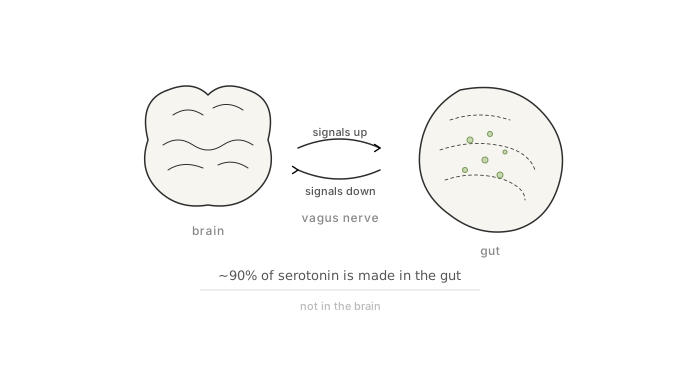
Here's something that surprises most people: around 90% of the body's serotonin — the neurotransmitter most associated with mood and emotional stability — is produced not in the brain, but in the gut.
The gut and brain are connected through what researchers call the gut-brain axis: a two-way communication system involving the vagus nerve, the immune system, and a vast community of microorganisms living in your digestive tract. What you eat shapes the composition of that community. And that community, in turn, shapes how you feel.
Owen and Corfe (2017) highlight how nutrient deficiencies — particularly in B vitamins, omega-3 fatty acids and zinc — are associated with higher rates of depression and anxiety. These aren't exotic deficiencies. They're common, often unnoticed, and largely influenced by what we choose to eat.1
What the research actually says
A large review by Brooks et al. (2024) found that Mediterranean-style diets — rich in fruits, vegetables, whole grains, legumes and healthy fats — are consistently associated with better mental health outcomes across different populations and age groups.2 This isn't a niche finding. It's one of the most replicated patterns in nutritional psychiatry.
For young adults specifically, the picture is particularly clear. Solomou et al. (2023) found that students who eat more fruits, vegetables and whole grains report significantly fewer symptoms of anxiety and depression.3 Wilson et al. (2020) confirmed that low nutritional quality is linked to mental health symptoms in people aged 18–24 — a group already navigating significant stress.4
The same pattern holds across the life span. Pasco et al. (2014) showed that children and adolescents eating healthier diets have better emotional well-being.5 Camprodon-Boadas et al. (2024) found the Mediterranean diet may offer some protection against depression, anxiety and ADHD symptoms in young people.6
And Coon and Benton (1993) found that women eating more fruits and vegetables reported significantly better mental health scores — though the effect was less pronounced in men, suggesting the relationship may have gender-specific dimensions worth exploring.7
So what should we actually eat?
The research doesn't point to superfoods or complex protocols. It points to patterns — consistent, everyday choices that add up quietly over time.
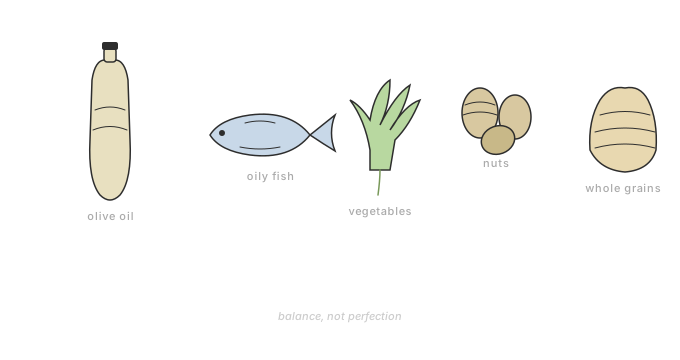
- Eat more: Fruits, vegetables, legumes, whole grains, nuts, oily fish, olive oil
- Eat less: Processed snacks, sugary drinks, refined carbohydrates, trans fats
- Most importantly: Aim for consistency, not perfection
What this means for you
Mental health is genuinely complex. It involves genetics, environment, sleep, relationships, stress history — and yes, what you eat. Food isn't a cure. It won't replace therapy or medication for someone who needs them.
But it is one of the most accessible things you can do. Every meal is a small decision that either supports or quietly neglects the brain running everything else. And unlike most health interventions, it doesn't require a prescription, a diagnosis, or a crisis to get started.
You might start by noticing. How do you feel after different kinds of meals? Where are the patterns? Not to control or restrict — but to understand. That's where things usually begin to shift.
Read next
What does holistic health really mean?